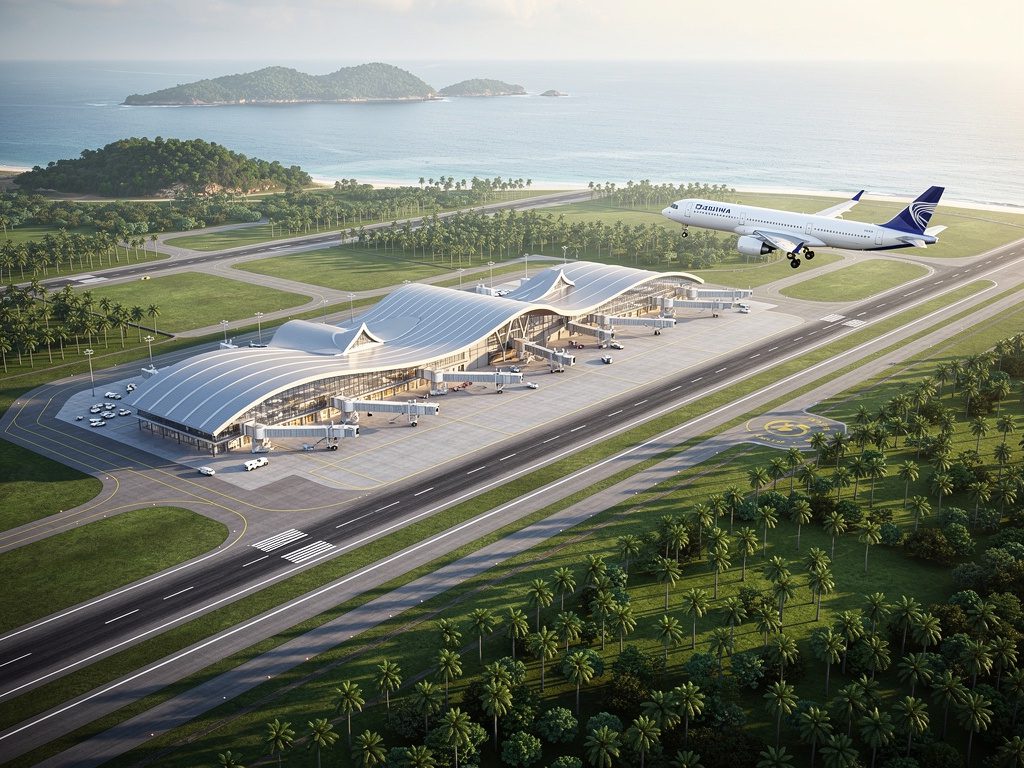
Phuket’s airport is running close to capacity, and the plans for a second airport in Phang Nga are taking clearer shape.
At the Phuket Real Estate Association’s sustainability seminar on 23 September 2026, a speaker representing Dr Jiraroth Sukolrat, Director of the Office of Transport and Traffic Policy and Planning, presented the Airports of Thailand plans for the Andaman International Airport.
The project in numbers
The airport is planned for Khok Kloi in the Takua Thung district of Phang Nga, 23.4 kilometres north of Phuket International Airport and a 26 minute journey away. The slides set out the scale: 7,300 rai of land, capacity for 20 million passengers a year, a terminal built for 22.5 million, two runways handling 43 flights an hour and 44 aircraft stands.
For comparison, the slides put Phuket International Airport’s current capacity at 12.5 million passengers a year and 25 flights an hour.
Airports of Thailand has set out a seven year programme, three years for research and development and four for construction, with the airport slated to open by 2031. It expects at least 15 million more tourist arrivals a year to the Andaman region.
The order of work
Both Phase 2 of the Phuket Airport development and the Andaman International Airport were marked as quick win projects. “In principle, the focus is on developing the current airport first,” the speaker said.
That matches wider reporting. In July 2025, a market report said Airports of Thailand would prioritise expanding Phuket International Airport after land issues slowed the Phang Nga site. In May 2026, Airports of Thailand confirmed it was studying the investment feasibility of the Andaman Airport, with the study to go to Cabinet once approved.
Asa Marsh on Phang Nga
“Phuket’s international airport is already so popular, with people coming in and out every single day,” said Asa Marsh, Managing Director of Easy Living Phuket. “The government pushing infrastructure projects and approvals into Phuket shows they’re serious about making Phuket the golden crown of Thailand’s tourism.”
“Right now the area around the new airport is sleepy, beautiful and quiet. If people are flying in there, there’s going to be a lot more short term stays, and the area is going to grow.”
“Real estate in Phang Nga is already rising in price. Land around the golf course and along Natai Beach is going up. With the nominee crackdowns in the news, I believe condominiums are going to be the driving force for foreigners investing in Thai real estate.”
What buyers need to know about ownership
The legal framework shapes what foreigners can buy near the new airport. Foreigners can hold freehold title to a condominium unit, provided foreign ownership stays within 49% of the building’s floor area. Land cannot be owned directly by a foreigner, and registered leasehold is the recognised route for villas and land.
Company structures are under close review. Since 1 January 2026 the Department of Business Development has required proof of source of funds for newly incorporated Thai companies, extended to company amendment filings from 1 April 2026. Any structure that relies on nominee shareholders carries real risk.
How we would approach it
Phang Nga offers space, beaches and a pace of life that Phuket’s busier areas have moved past. A new airport would bring the rest of the world much closer to it.
Our advice is to buy with clean title and a structure that stands up to scrutiny, and to value a property for what it offers now. The airport timeline depends on feasibility, Cabinet approval and construction, and an Environmental Impact Assessment still lies ahead.
Our vetted legal and advisory network reviews every title and structure before our clients commit. If you’d like to talk through property in Phang Nga or the north of Phuket, speak to the Easy Living Phuket team.
This article is for general information only and is not legal, tax or financial advice.